Functional Space Design Is Not a Feature. It’s the Foundation.

 In commercial real estate, we often talk about sustainability, resilience, and aesthetics. But before any of that matters, a building has to do something very simple:
It has to work.
Functional design — sometimes called operational performance — is not glamorous. It doesn’t trend on social media. But it is the underlying discipline that determines whether a building actually supports the people and processes inside it.
When it fails, everyone feels it.
Start With Purpose, Not Form
Every project begins with a reason for existing.
A school must support learning.
A hospital must support care delivery.
A retail store must support customer flow and sales conversion.
An office must support collaboration and focus.
Functional design starts by clearly defining that purpose. Not abstractly — but operationally.
What activities will happen here?
Who performs them?
In what sequence?
With what adjacencies?
Under what constraints?
Too many projects rush into layouts and finishes before this clarity is established. The result? Beautiful spaces that don’t quite function.
Translate Needs Into Space Logic
Function is not guesswork. It is translation.
User requirements become spatial requirements.
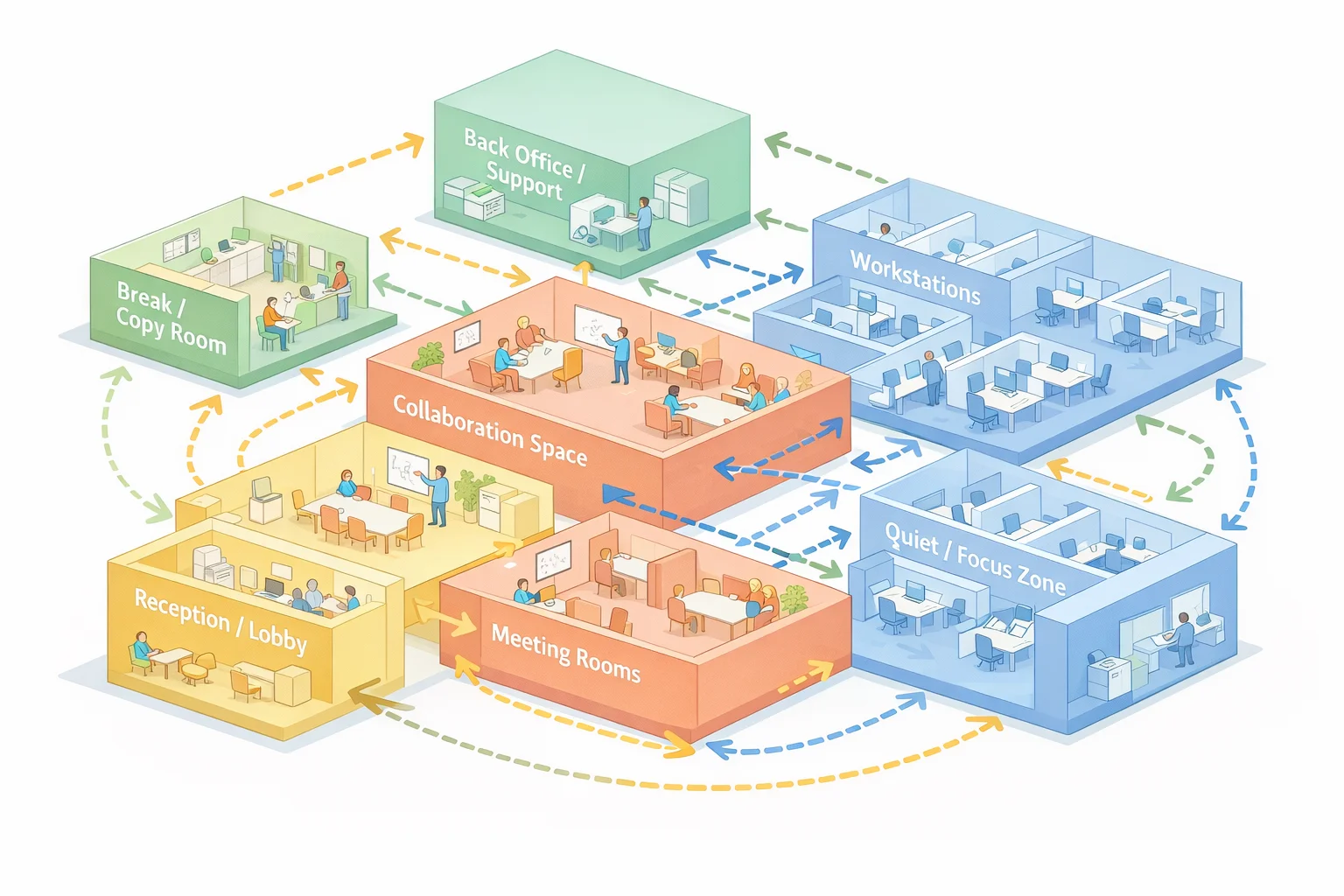
Operational processes become adjacency diagrams.
Capacity targets become square footage calculations.
This is where disciplined programming matters.
Defining goals early — and validating them with stakeholders — prevents expensive redesigns later. It also ensures that design decisions are tied to real operational outcomes rather than preferences.
When done correctly, programming reduces ambiguity. It aligns teams. It de-risks projects.
Design for Change, Not Just Today
Buildings rarely stay static.
Teams grow. Equipment changes. Technology evolves. Business models shift.
A functionally sound building anticipates this.
This doesn’t mean designing for every hypothetical future — but it does mean:
Structuring systems to allow reconfiguration
Avoiding rigid layouts where flexibility is possible
Coordinating structural, mechanical, and spatial frameworks thoughtfully
Flexibility is not accidental. It is embedded in the early logic of the building.
Integrate Systems, Don’t Stack Them
A building is not a collection of independent parts.
Architecture, structure, MEP systems, IT infrastructure, security, and interiors must operate as a coordinated system. When disciplines work in silos, the result is friction:
Mechanical conflicts with structure
Technology retrofitted after the fact
Security requirements disrupting user flow
Functional performance depends on integration. That integration begins at the planning stage — not during construction coordination.
Function Is a Lifecycle Commitment
Functional performance is not verified at ribbon-cutting.
It extends through:
Pre-design programming
Design coordination
Construction quality assurance
Commissioning
Post-occupancy evaluation
A building that functions well on day one but fails operationally two years later was not fully resolved.
Operational success requires clarity of intent, documentation discipline, and follow-through.
Why This Matters More Than Ever
Commercial real estate today operates under tighter margins, faster timelines, and greater complexity.
When a building fails functionally, the cost is not just financial. It shows up as:
Operational inefficiency
User frustration
Lost productivity
Rework and retrofit expenses
In contrast, when a building works seamlessly, no one talks about it — because it simply performs.
And that is the point.
The Foundation, Not an Afterthought
Functional design is not a checklist item. It is the foundation upon which every other design objective rests.
A sustainable building that doesn’t work operationally is still a problem.
A beautiful building that disrupts workflow is still inefficient.
A technologically advanced building that frustrates users still fails.
Before form.
Before finishes.
Before features.
Start with function.
Because when a building truly works, everything else becomes easier.